Essential hand tools to buy first
A short list of good hand tools will do more than a cupboard full of cheap sets. Here is what to buy first, roughly in order, and what to check before you pay.
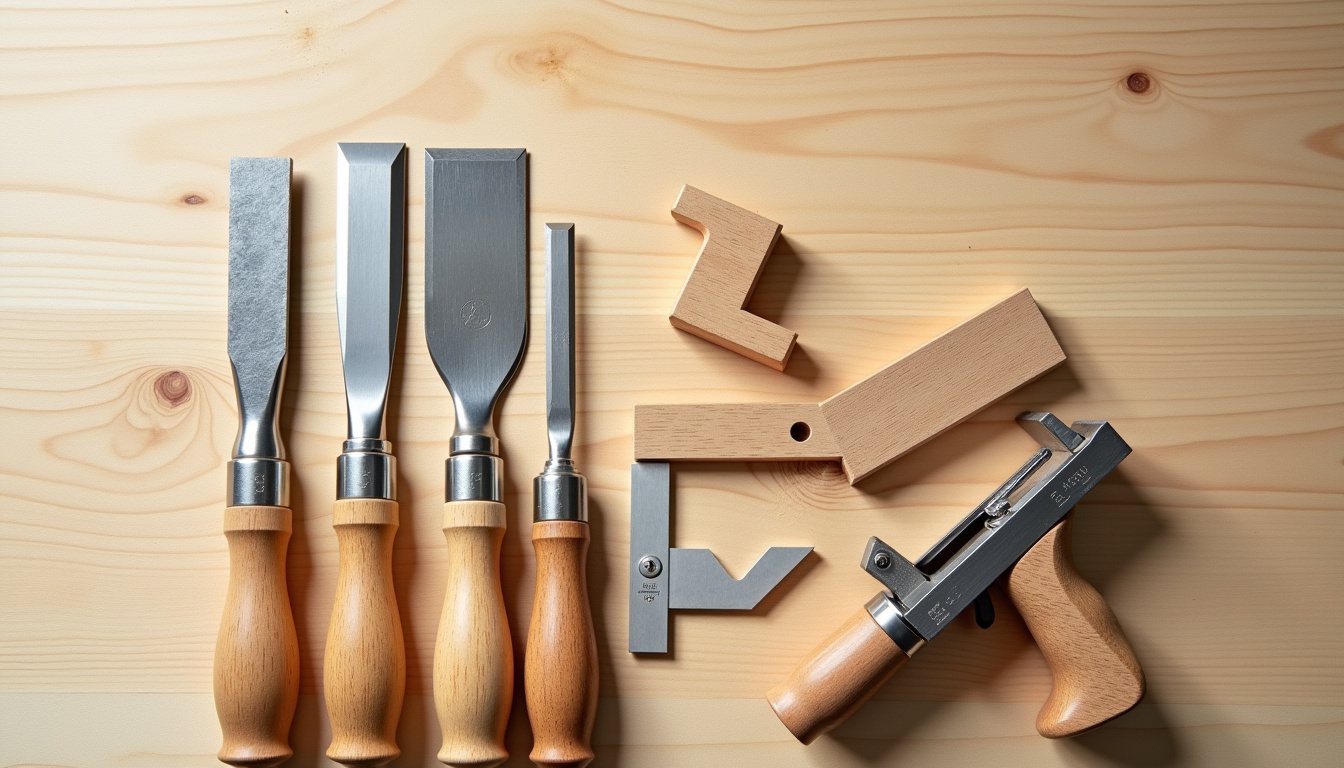
The right first tools are the ones that let you measure accurately, cut to a line, hold work still and fasten it together. Everything else builds on those four abilities. This list assumes general woodwork and household repairs; if your main interest is metalwork or bikes, the measuring and holding sections still apply but the cutting tools will differ.
Measuring and marking
Accuracy starts here, and these tools are cheap compared with the timber they save.
- Tape measure, 5 m or 8 m. A wide, stiff blade is easier to use on your own. Check that the hook slides slightly; it is designed to move by its own thickness so inside and outside measurements both read true.
- Steel rule, 300 mm. More precise than a tape for short measurements, and doubles as a straightedge.
- Combination square. Marks 90 and 45 degrees, measures depths and sets marking gauges. Check it is square before you rely on it (our measuring and marking guide shows how).
- Marking knife and a sharp pencil. A knife line is finer than any pencil and gives a chisel or saw something to register against.
- Marking gauge. Scribes a line parallel to an edge. A wheel gauge is easier to use across the grain than a pin gauge.
- Spirit level. A 600 mm level covers most shelves and frames; add a longer one when you need it.
Sawing
- General-purpose panel saw. Around 7 to 8 teeth per inch, 500 to 550 mm long, for cutting boards to length and rough ripping. A hardpoint saw is a reasonable first purchase.
- Pull saw or tenon saw. A finer-toothed saw for accurate joints and trimming. Pull saws cut on the pull stroke, have thin blades and are easy for beginners to control. A backed tenon saw does the same job in the push-stroke tradition.
- Junior hacksaw and full-size hacksaw. For metal, plastic pipe and the bolt that is always slightly too long.
- Coping saw. For curves and removing waste from dovetails.
Chisels
A set of four bevel-edged chisels covers most work. Look for flat backs (check with a straightedge in good light), handles that will take a mallet, and steel that is not so soft it folds on the first knot. Expect to flatten and sharpen them before first use, even when new. Our sharpening guide explains how.
Keep them in a roll or rack with the edges covered. A chisel rolling about loose in a drawer will be blunt and chipped within a month.
Planes
- Block plane. Small, one-handed and endlessly useful for chamfers, end grain and trimming. If you buy only one plane, buy this.
- Smoothing plane (No. 4 size). Flattens and smooths faces and edges. Second-hand examples are common and often good once tuned.
A plane is only as good as its iron. A cheap plane with a carefully sharpened iron will outperform an expensive one with a dull edge.
Holding work
Work that moves gets ruined and hands get cut. Holding tools are where beginners most often under-spend.
- Clamps. Four F-clamps or sash-style bar clamps of 300 mm capacity is a start. You will want more; everyone does.
- A vice. A woodworking vice fitted to the bench, with wooden jaw liners, holds work for sawing and planing. An engineer's vice is better for metal.
- Bench hook. A simple board with a lip on each side that hooks over the bench edge and holds small pieces for cross-cutting. Easy to make yourself.
Fixing and assembly
- Claw hammer, around 16 oz. Heavy enough to drive nails, light enough to control.
- Wooden or rubber mallet. For chisels and for tapping joints together without bruising them.
- Screwdrivers. At least Pozidriv sizes PZ1 and PZ2, plus a couple of flat-blade drivers. Many UK wood screws are Pozidriv, and using a Phillips driver in them will cam out and chew the head. See our fixings guide.
- Bradawl. Starts small screw holes and marks centres.
- Nail punch. Sets nail heads below the surface.
General tools
- Utility knife with snap-off or replaceable blades.
- Combination pliers, long-nose pliers and side cutters.
- An adjustable spanner and a small set of hex keys.
- A small flat file and a cabinet rasp for shaping.
- A sharpening setup. This is not optional if you buy chisels or planes.
A first-purchase table
| Priority | Tools | Why first |
|---|---|---|
| 1 | Tape, steel rule, combination square, knife, pencil | Every job starts with an accurate mark |
| 2 | Panel saw, pull saw, clamps | Cut and hold timber safely |
| 3 | Hammer, screwdrivers, bradawl | Assemble and repair |
| 4 | Chisels, block plane, sharpening kit | Fit and trim parts properly |
| 5 | Marking gauge, smoothing plane, coping saw, files | As projects demand |
What to check before you buy
Pick tools up. A hammer should feel balanced, a saw handle should fit your hand without pressure points, and a square should sit flat. Read the specification for steel type and whether the tool can be resharpened. Avoid sets padded out with sizes you will not use. And budget for sharpening equipment alongside edge tools, because a blunt chisel is both useless and dangerous: it needs more force, and force is what makes it slip.
Tools you can safely leave until later
Some tools appear on every beginner list but earn their place only once you know what you need. A full set of carving gouges, a large collection of specialist planes, a dovetail saw and a tenon saw and a pull saw all at once, a laser level, or a wall of identical clamps in one size can all wait. Buy the second clamp size when a glue-up shows you need it, and the specialist plane when a job is genuinely held up without it. This keeps money free for timber, which is what you actually learn from.
The same goes for duplicates. One good square is better than three doubtful ones, because you will always reach for the one you trust and the others become clutter.
Looking after a new kit
Hang or rack tools so edges do not touch each other, wipe steel with a lightly oiled cloth after handling, and keep everything in the driest part of the workshop. Our tool care guide explains rust prevention in more detail.
When your hand tool kit starts to feel limiting, our guide to first power tools covers what to add next.