Workshop safety and PPE
Most workshop injuries come from a handful of predictable causes. Good habits deal with most of them; personal protective equipment handles what is left.
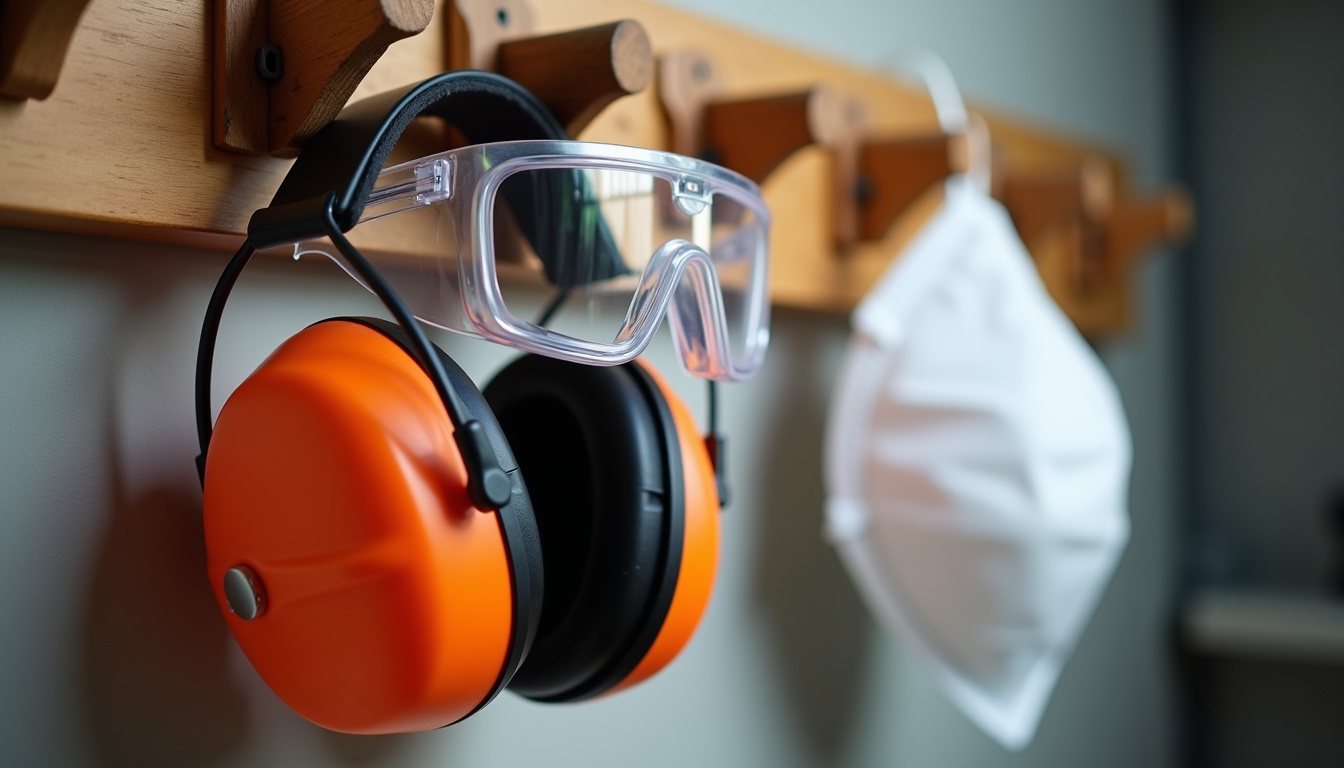
Workshop injuries tend to repeat the same patterns: a chip in the eye, a cut from a slipping chisel, a hand drawn towards a blade, years of noise and dust doing damage you do not notice until later. None of these is inevitable. This guide covers the protective equipment worth owning and, more importantly, the habits that mean you rarely need it to save you.
Health and Safety Executive (HSE) regulations cover workplaces rather than hobby use at home, but HSE's published guidance on woodworking, noise and respiratory protection is the best UK reference for anyone using tools.
Habits first
- Keep edges sharp. A blunt chisel or blade needs more force, and force is what makes tools slip.
- Cut away from yourself and keep both hands behind the cutting edge.
- Clamp the work. If you are holding the work with one hand while using a power tool with the other, stop and clamp it.
- Isolate before adjusting. Unplug or remove the battery before changing blades, bits or cutters.
- Keep the floor clear. Offcuts and cables underfoot cause trips at the worst moments.
- Do not work tired, rushed or after alcohol. Most people who have had a close call can name which of those applied.
- Tie back long hair, remove loose sleeves and jewellery around anything that rotates.
Eye protection
Wear eye protection for every power tool operation, for chiselling, for striking anything with a hammer and when working with chemicals. Safety spectacles and goggles sold in the UK are marked to EN 166. The mechanical strength code tells you what impact they are rated for: F for low-energy impact, B for medium energy and A for high energy, with S indicating increased robustness only. For general workshop use, F-rated spectacles with side protection are the minimum, and goggles are better for grinding, overhead drilling and anything that throws fine particles.
If you wear glasses, buy over-specs designed to fit over them, or prescription safety glasses. Anti-fog coatings help a great deal if you also wear a mask.
Hearing protection
Noise damage is permanent and painless, which is why it is so often ignored. UK workplace rules set action levels at a daily average of 80 dB(A) and 85 dB(A). Routers, planers, circular saws and many sanders exceed 85 dB(A) at the operator's ear, often by a wide margin, so even short sessions add up. A rule of thumb used by HSE: if you have to raise your voice to talk to someone two metres away, the noise is likely to be at a level that needs protection.
- Ear defenders are quick to put on and take off, which means you are more likely to wear them for a ten-second cut.
- Foam plugs give good protection if inserted properly, rolled tight and allowed to expand deep in the canal.
- Check the SNR (single number rating) on the packaging. Higher is more protection, but over-protection that cuts you off from all sound is not ideal either.
Respiratory protection
Wood dust is not harmless. HSE notes that it can cause asthma and dermatitis, and hardwood dust is classed as a carcinogen linked to nasal cancer. MDF dust is fine and gets everywhere. The best protection is controlling dust at the source with extraction (see our dust extraction guide); a mask is the last line of defence, not the first.
- FFP2 disposable respirators (EN 149) are the minimum for wood dust.
- FFP3 gives a higher level of protection and is the sensible choice for hardwoods, MDF, long sanding sessions and old painted surfaces.
- Reusable half masks with P3 filters are comfortable for regular use and cheaper over time.
- Fit is everything. Tight-fitting masks only work against clean-shaven skin; stubble breaks the seal. If you have a beard, a powered air-purifying respirator with a loose hood is the alternative.
Old paint may contain lead, and some older buildings contain asbestos in boards, floor tiles and textured coatings. Do not sand, cut or drill suspect materials. Asbestos work needs specialist assessment; see HSE's asbestos guidance.
Dust classes L, M and H
Dust extractors and vacuum cleaners used for hazardous dust are classified under EN 60335-2-69 by how much dust passes through their filtration.
| Class | Maximum dust passing through | Typical use |
|---|---|---|
| L (low) | Less than 1% | General dust and dust of low hazard |
| M (medium) | Less than 0.1% | Wood dust, including hardwoods and MDF, and dust from filler, plaster and concrete |
| H (high) | Less than 0.005% | Highly hazardous dust such as carcinogens and dust containing pathogens |
For a woodworking workshop, an M-class extractor is the sensible target. H-class extractors are used in some licensed and specialist work; owning one does not make it safe or legal for a homeowner to disturb asbestos.
Hands, guards and push sticks
Guards exist because hands go where they should not, usually in the half second after something unexpected. Never remove a guard to make a cut easier; if a cut cannot be made with the guard in place, find another way to make it.
- Push sticks and push blocks keep fingers well clear of table saw and router table cutters. HSE guidance on circular saw benches calls for a push stick to feed the last 300 mm of a cut and for feeding narrow pieces. Make several and keep them within reach.
- Riving knife fitted and adjusted on any table saw, as described in the manual.
- Featherboards hold work against the fence and down to the table so your hands do not have to.
- Stand to one side of a table saw blade, out of the line of any kickback.
- Gloves protect against splinters and sharp metal edges, but never wear them near rotating cutters or drill chucks.
Feet and clothing
Sturdy closed shoes are the minimum; safety boots with toe protection are worth it if you handle heavy timber or machines. Wear close-fitting clothes, roll sleeves above the elbow when using machines and keep a cotton or canvas apron for messy work. Synthetic fleeces attract dust and can melt if they catch sparks from grinding.
First aid and working alone
Keep a stocked first aid kit by the door, including large dressings, and know where your phone is. If you work alone with machines, tell someone when you start and finish. A small fire extinguisher suitable for the materials you keep, and a heat alarm, belong in every workshop; our planning guide covers fire risks in more detail.